Injury Time Rules: Why Matches Run Past 90
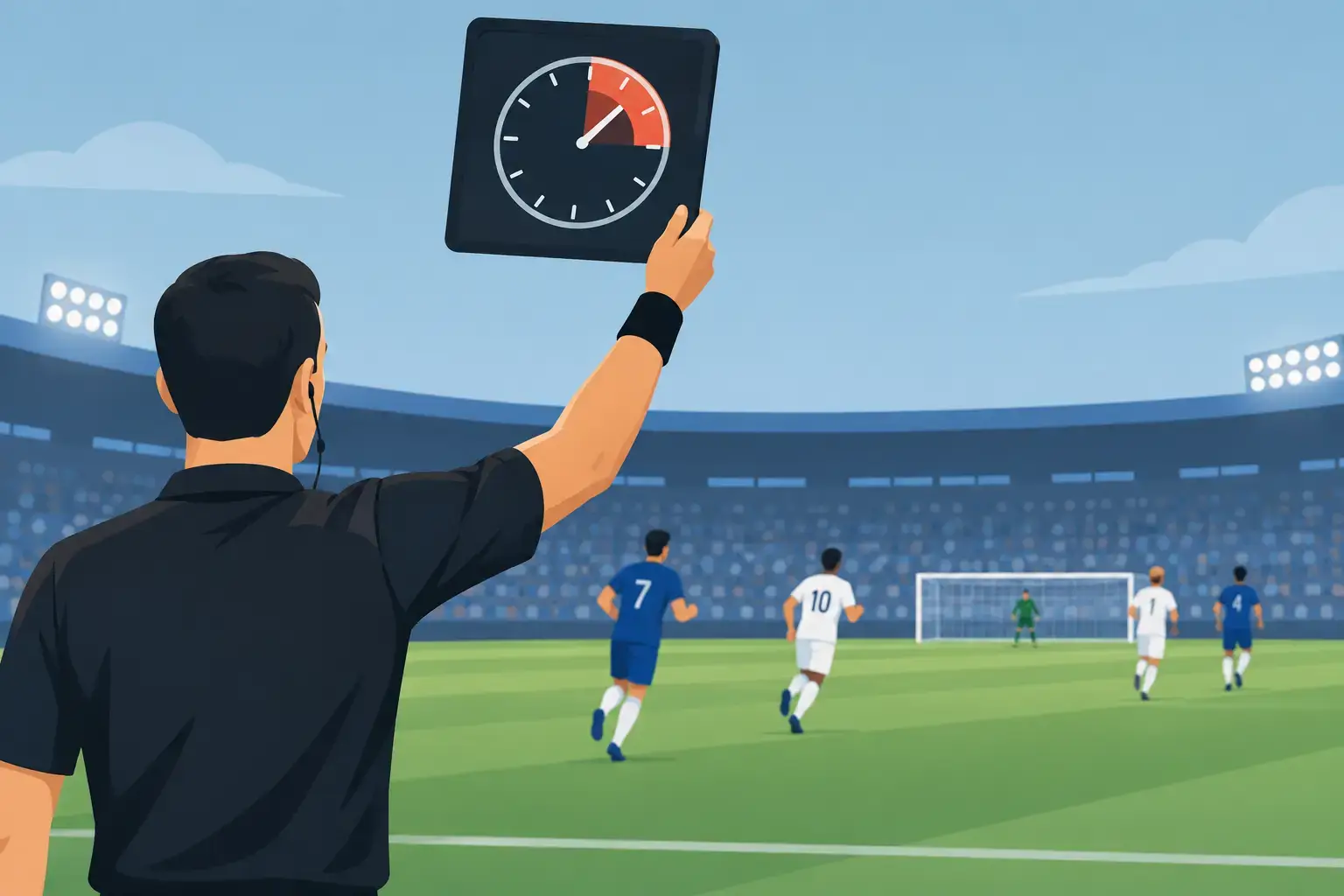
A board goes up showing five added minutes. Your side is one goal down. Then the clock reaches 95:00, 96:00, 97:00 - and the whistle still has not gone. That is usually not a mistake. Injury time rules give the referee room to recover time lost during a half, and the number on the board is only the minimum to be played.
For fans following a close finish, that distinction matters. Added time can decide a title race, a relegation battle, an accumulator or simply a noisy group chat. Here is how it works, what referees are adding time for, and why 90 minutes rarely means a match ends exactly on 90:00.
What injury time actually means
“Injury time” is the familiar phrase, but it is not the official term. The Laws of the Game refer to allowance for time lost, while broadcasters and scoreboards commonly use “added time”. You may also hear “stoppage time”. In normal football conversation, they all mean the extra minutes played at the end of each half.
The name can be misleading. Added time is not only for injured players. A half can be extended because of substitutions, VAR checks, goals, disciplinary incidents, delays caused by time-wasting, or any other significant interruption.
The key point is simple: the referee is responsible for keeping time. The match clock shown on television, in the ground or on a live-score page helps supporters follow the action, but it does not overrule the referee’s watch.
The basic injury time rules
Under Law 7 of the Laws of the Game, the referee must make an allowance for time lost in either half. That applies to the first half as well as the second, and it also applies in extra time when a competition uses it.
The referee considers delays such as:
- substitutions;
- assessment or removal of injured players;
- time-wasting and other tactical delays;
- disciplinary action, including cards and dissent;
- goal celebrations;
- VAR checks and on-field reviews;
- drinks breaks, medical pauses and other permitted stoppages;
- any significant delay not covered elsewhere.
Not every pause produces a second-for-second calculation. Football is not played with a publicly visible stopped clock, and referees use judgement over what counts as meaningful lost time. A routine throw-in delay is part of the game. A player slowly leaving the pitch, a lengthy treatment break or a three-minute VAR review is a different matter.
That judgement is why two matches with a similar number of stoppages can have different amounts of added time.
The fourth official’s board shows a minimum
Near the end of each half, the fourth official displays a number. If it says “+4”, the half will last for at least four additional minutes. It does not mean the referee must blow the whistle at exactly 49:00 or 94:00.
If another delay happens during those four minutes - perhaps a goal, an injury, a substitution or a confrontation - the referee can add more time. This is why a match may continue well beyond the figure first shown.
Think of the board as a floor, not a finish line. For live followers, the status remains in added time until the referee ends the half, regardless of what the running clock says.
Can the referee reduce the announced time?
No. Once the minimum added time has been indicated, the referee cannot cut it short simply because the ball has been in play or one team wants the whistle. More time can be added for further lost time, but the displayed minimum still has to be completed.
There is one practical wrinkle: a referee may end a half just before the displayed clock reaches an exact second because the indicated number is a minimum estimate rather than a broadcast countdown. But they cannot decide that two of four announced minutes are enough.
Why added time has become longer
Fans have noticed more eight-, nine- and 10-minute additions in high-level football. That is no accident. Recent guidance has encouraged officials to account more accurately for long stoppages, especially goal celebrations, treatment breaks and VAR delays.
The aim is not to create drama for its own sake. It is to protect playing time. If a team spends a large part of a half slowing restarts or celebrating a late goal, allowing only a token amount of added time rewards the delay.
Still, more added time brings a trade-off. Longer matches put extra physical demand on players, particularly in congested fixture lists, and can make the closing stages feel unpredictable. But from a sporting perspective, the case is straightforward: the ball should be in play for more of the scheduled contest.
Injuries, substitutions and time-wasting
An injury does not automatically mean a fixed number of minutes will be added. The referee looks at the real delay. A player receiving quick treatment and returning to the pitch may lead to little or no visible addition. A serious injury requiring a stretcher, medical staff and a long pause will usually lead to more.
Substitutions are also considered, though their impact depends on how quickly they happen. A standard change in normal flow is one thing. Several substitutions in the final minutes, with players taking their time to leave the pitch, can add up quickly.
Time-wasting sits at the heart of many arguments about stoppage time. Goalkeepers delaying a goal kick, players standing over free-kicks and teams taking an age over substitutions can all affect the referee’s calculation. Cautions may punish the behaviour, while added time protects the opponents from losing too much playing time.
That does not mean referees can perfectly correct every delay. They must manage the match, safety, player behaviour and the overall flow at the same time. Added time is an allowance, not a forensic replay of every second.
VAR and goals can extend a half
VAR has made the end of matches more complicated. A check for offside, a possible penalty or serious foul play can take time, particularly when the referee is asked to review the incident at the pitchside monitor. That time is normally added.
Goals can also create more added time, even when they arrive after the board is shown. Celebrations, restarts and any VAR confirmation take time away from play. A late equaliser at 90+4 can therefore be followed by several more minutes.
This is why the scoreline alone never tells you whether a match is nearly finished. Watch the match status and the events. On FunkyScore, the timeline is useful here: a goal, card, substitution or VAR review after the added-time board appears can explain why the final whistle has not arrived.
Does a penalty have to be taken after time is up?
Yes. If a penalty kick is awarded just before the end of a half, the referee extends the half so the kick can be completed. The same applies when a penalty is retaken.
“Completed” has a specific meaning. The kick is over when the ball stops moving, goes out of play, enters the goal, is saved, or the referee stops play for an offence. There is no follow-up phase after a saved penalty in this situation. If the goalkeeper saves it and the ball rebounds to the taker, the half ends rather than allowing a second shot.
A direct free-kick, corner or attacking throw-in is different. Teams are not entitled to take one final set piece because the clock has reached the announced minimum. The referee can end the half before it is taken.
Added time versus extra time
These terms are easy to mix up, but they describe different things. Added time happens at the end of a normal half to account for stoppages. Extra time is a separate period, usually two 15-minute halves, used in certain knockout matches that are level after 90 minutes.
Extra time has its own added time. So a cup tie can reach 120 minutes and then continue to 120+2 or 120+5 if delays occur during extra time. If it is still level, the competition rules may send the match to penalties.
What fans should watch in the closing minutes
When a match enters added time, do not treat the number after the plus sign as an exact expiry time. Look for the events that could create further delay: treatment, substitutions, cards, goals and VAR reviews. A team protecting a lead may also try to slow the tempo, but that can backfire if the referee responds with extra time and disciplinary action.
The best habit is simple: follow the live status, not just the clock. Until the referee blows for half-time or full-time, the match is still live - and football has a habit of making those final seconds count.